Home Blog

Rihanna’s Most Memorable Hair Looks Ever

0

Rihanna is known for a lot of things: Her one-of-one personal style, her DGAF attitude, her beauty empire, and her knack for giving us exactly what we need when we need it. Case in point: When makeup brands refused to expand their shade ranges, the singer took the lead and launched her shade-inclusive Fenty Beauty brand. And now, she’s coming to bless our tresses with Fenty Hair.

To celebrate the launch of her forthcoming haircare line at an event on June 10, the mogul walked rocked her natural hair, dyed a gorgeous caramel hue. This is the first time we’ve seen the singer wear her natural hair in some time, and it’s a pretty significant moment. Historically, Black hair has been a point of symbolism as well as contention in society, with many outside the textured hair community deeming natural hair and protective styles like braids as “unruly” or “unprofessional.”

At its core, discrimination against textured hair is rooted in racism and white supremacy, and the notion that hair that looks different from the “norm” (i.e. white) is inherently wrong, bad, or unprofessional. And while times have somewhat evolved — and people have the right to wear their hair however makes them feel good, whether that’s curly, relaxed, braided or in flowing waves — hair discrimination still exists and that makes Rihanna’s decision to publicly embrace her natural hair so important.

Despite the significance of Rihanna’s gorgeous natural coils, this is far from the first time RiRi has given us the ultimate hair inspo; the singer is known for switching up her hairstyle and always leaving fans in awe — and running to their stylists. Below, some of the most iconic Rihanna hair moments of all time.

The Fenty Hair era


View this post on Instagram


A post shared by FENTY HAIR (@fentyhair)

Rihanna’s latest hair moment is arguable one of our faves — and not just because it’s top of mind. We love that the singer is embracing a short naturally curly hairdo, not to mention its luscious cookie batter colour. For a haircare line that’s all about inclusivity and catering to people who want to embrace their true selves, it only seems fitting.

Long, dark and curly


View this post on Instagram


A post shared by badgalriri (@badgalriri)

It seems that keeping her black hair long and curly is a staple for Rihanna, who periodically returns to a similar style, or slight variation of it, sometimes experimenting with a new hue or length. We love this particular look because it reminds us of OG RiRi, when she was an emerging artist from Barbados.

Her Guava Island braids


View this post on Instagram


A post shared by badgalriri (@badgalriri)

Marking her return to acting after a few years off, Rihanna stepped into her role as Kofi Novia in 2019’s Guava Island with knotless box braids.

The ’60s bob


View this post on Instagram


A post shared by badgalriri (@badgalriri)

Ever a fan of channelling a moment in time when it comes to her hairstyle, the “Diamonds” singer paid homage to the 1960s with this chic bob.

Rihanna’s blonde shag


View this post on Instagram


A post shared by badgalriri (@badgalriri)

Sorry, but this look lives rent free in our minds. A blink-and-you’d-miss-it style, Rihanna channeled the 1970s for a February 2017 shoot with Vogue, looking like the most stylish Top Gun recruit ever with a blonde shag cut. (She previously donned a blonde curly shag in 2012.)

A pop of blue


View this post on Instagram


A post shared by badgalriri (@badgalriri)

Never one to shy away from a little colour, this short but sweet blue moment to kick of 2017 is still a memorable look in the singer’s hair repertoire.

Rihanna’s dreadlocks era


View this post on Instagram


A post shared by badgalriri (@badgalriri)

In 2015, fashion commentator Giuliana Rancic infamously made rude comments about actress Zendaya donning dreadlocks on the red carpet, and just a year later, Rihanna reinforced that Rancic’s comments weren’t only out of line (not to mention racist), but also completely wrong.

The iconic short red hair phase


View this post on Instagram


A post shared by badgalriri (@badgalriri)

2015 Bad Gal RiRi was arguably one of the beauty founder’s best style years. And nowhere was that more apparent than during her Met Gala appearance that year. The singer not only nailed the evening’s theme, ascending the stairs in a yellow Guo Pei gown, but she did so with a chic red bob. The perfectly flipped out ends gave just enough sass to balance out her distinct look.

Bantu knots


View this post on Instagram


A post shared by badgalriri (@badgalriri)

Despite the fact that she only wore the style for a few hours, while presenting at a 2014 awards show, we were obsessed with the singer’s Bantu knots.

The updated Edna moment


View this post on Instagram


A post shared by badgalriri (@badgalriri)

In 2014, Rihanna, now well-known for her edgy looks, debuted a classic blunt bob and matching bangs.

Rihanna’s unforgettable 2013 short hair

View this post on Instagram


A post shared by badgalriri (@badgalriri)

Arguably her most memorable haircut, Rihanna’s 2013 short hair era was a moment. While she had experimented with shorter hair before and would continue to do so in the decade to come, this specific foray into cropped locks was RRii at her edgy best. The blonde! The side shave! That volume! This was the first aesthetic sign that our girl wasn’t afraid to take risks when it came to her hairstyles.

Embracing her natural hair


View this post on Instagram


A post shared by badgalriri (@badgalriri)

Over a decade before she stepped out for Fenty Hair rocking her natural curl pattern, the mogul first gave fans a glimpse of her gorgeous coils while celebrating Carnival in her native Barbados.

Ahead-of-its-time ombré


View this post on Instagram


A post shared by badgalriri (@badgalriri)

Proving she’s always been a step ahead of trends, Rihanna paved the way for the soon-to-be popular ombré hair, stepping out in the look at the 2013 Grammy Awards.

The OG pixie cut


View this post on Instagram


A post shared by badgalriri (@badgalriri)

Probably one of the biggest hair departures at the time for the new-ish singer (she also went red in 2010) was her 2012 pixie cut featuring a micro fringe. This one sent the internet into a tizzy — and fans everywhere to their hairstylists’ chairs asking for a similar chic cropped cut.

The post Rihanna’s Most Memorable Hair Looks Ever appeared first on FASHION Magazine.

[#content_feedzy_rewrite] 
Here’s What It’s Like Maintaining Black Hair While Filming for Reality TV

0

This is Texture Talk, our long-running column that deep dives into the dynamic world of curly hair, from crowns of curls that are free flowing to strands that are tucked away in a protective style.

The first time I watched an episode of The Bachelor was a decade ago. It caught my attention as I was scrolling through channels, browsing for something to watch, and I was hooked almost immediately. Since then, my affinity for reality TV has grown exponentially and I’ve added The Bachelor spinoffs, Love Island, The Challenge and The Amazing Race to my roster.

So many things about the reality-TV experience pique my interest — but perhaps none more than the hair. As a Black woman, I often struggle to style and take care of my own hair, even with endless tools, products and stylists at my disposal. But many reality-TV stars are isolated for the duration of their show’s filming process. Every time I watch a Black contestant on TV, I wonder how they managed. What is it like for a Black woman to style her hair, with no access to her regular resources, when she knows that millions of people are watching? Allow three reality-TV stars to tell you themselves.

Tessa Tookes

The Bachelor season 26; Bachelor In Paradise Canada season 2

Photography by Victoria Malanowski

When I was cast for season 26 of The Bachelor, I really went by the books in terms of preparation,” says Tessa Tookes. “I got eyelash extensions and bought new makeup and an entirely new wardrobe. And I spent a lot of money on my sew-in. My hair alone probably cost $1,200.”

Tookes says that the time and money she spent before and during that season were more than just the result of nerves and excitement for her first-ever television gig. “I think that was me trying to compensate for confidence I didn’t have,” she recalls. “Maybe I wasn’t fully at peace with my identity at the time, and to me, that was reflected in the lengths I went to for my appearance. I’ll always remember the day before I got eliminated; I went into the kitchen and gave myself a silk press using Saran Wrap [since the plastic helps seal in moisture, resulting in smoother strands].”

When Tookes went on Bachelor in Paradise Canada the following year, things were different. “I’d learned more about my hair texture,” she says. “I still wore extensions, but that time, I chose a texture that mimicked my natural curls, to give me the option of wearing my hair naturally if I wanted to. But even then, I had 15 minutes to get ready for the first date. I was so rushed that in the end I wasn’t happy with how I looked. I felt like I never had enough time. I think that’s partly why the reality-TV experience feels less equal for women with textured hair.”

Serene Russell

The Bachelor season 26; Bachelor In Paradise season 8

Photography by Justin Macala

The women of colour were constantly battling against time with our hair,” says Serene Russell of her time on The Bachelor. “I opted to straighten mine because it just felt easier. Our schedule was unpredictable, so I thought, ‘If I know I’m going to be woken up in two hours, or only get four hours of sleep, at least my hair’s already done.’”

During the shooting of Bachelor in Paradise in Mexico, new challenges presented themselves. “There were times when I wanted to get in the pool or the ocean and swim with everyone else, but I knew that I might have to film shortly after, without having enough time to do my hair,” says Russell.

“At the end of the day, it’s a dating show,” she says. “You want to look your best, not only for national TV but also for the people you’re dating. I wish viewers would give women of colour a little more grace when it comes to their hair and appearance on these shows, because I had to work so hard just to feel presentable.”

Desi Williams

Survivor season 35; The Challenge: USA season 1; The Challenge: USA season 2

Photography by Jack Manning III/Jaxon Photo Group

I was on Survivor after being in the world of pageants,” says Desi Williams. “I went from an environment where looks mattered more than anything to not even having access to a mirror. Initially, it was really hard for me. I remember constantly wondering ‘How do I look? Do I look OK?’ It was a tough adjustment.”

After Survivor, Williams went on two seasons of The Challenge: USA, a spinoff of two MTV shows, The Real World and Road Rules. Similar to on Survivor, “hairstyling is totally on you during filming,” she says. “I had to think about my sanity. I could continue to think about the fact that cameras were around me at all times and do my hair and a full face of makeup every day — but was that realistic for eight weeks of filming? I decided the only time it really mattered how I looked was when I filmed my confessionals. Otherwise, a head scarf and edge control went a long way.”

The second season of The Challenge: USA was filmed in Croatia. “All the handlers were white,” says Williams. “They tried to be as helpful as possible, but they rarely understood what I was asking for. I remember asking for a hot comb and they were like, ‘What is a hot comb?’” she laughs. “But you know what? They went online and they found me a hot comb!” Overall, Williams is happy with the direction in which the world of reality TV is headed. “I feel like reality television is finally in a place where it wants to honour Black queens.”

This article first appeared in FASHION’s Summer 2024 issue. Find out more here.

The post Here’s What It’s Like Maintaining Black Hair While Filming for Reality TV appeared first on FASHION Magazine.

[#content_feedzy_rewrite] 
Summer Fridays Drops a New Lip Butter Balm Flavour + More Beauty News

0

Summer Fridays makes Iced Coffee a permanent member of the Lip Butter Balm family

At this rate we’re never kicking our iced coffee or our lip balm habits. Meet Summer Fridays’ latest addition to their beloved Lip Butter Balm lineup: Iced Coffee. The newest member of the family is actually not so new. It was part of a limited-edition trio that you could shop last fall, but it was such a smashing success that the brand has brought it back as a permanent part of the lineup.

And thank goodness they have. Featuring the same buttery smooth formula as the rest of the vegan balms, the Iced Coffee flavour offers a hint of cocoa butter and a touch of — duh — iced coffee flavour.

Shop Now

Glasshouse Fragrances launches a collection of summery scents

Though burning a candle or turning on a diffuser may be mostly associated with cozy autumn evenings, the right scents can instantly fill a space with tropical, summery vibes when the weather warms up. Glasshouse Fragrances has just released four wanderlust-inducing scents that deserve a spot in your home this season.

From tangelo and geranium scented Sunkissed in Bermuda and grapefruit-noted St. Barts Bronze to wild mint Perfect Palm Springs and peony rose Music City Magic, Glasshouse has got your summer scents sorted. Each fragrance is available in a one-wick or two-wick candle, or an Eau de Cologne Fragrance Diffuser application.

Shop Now

Rare Beauty drops an exfoliating body wash

If you like to bare your legs during the summer, exfoliating will be key for achieving your smoothest skin. Rare Beauty‘s new launch is just what you’ll need for a pre-pool day body polish. Joining the brand’s Find Comfort collection, this Gentle Exfoliating Body Wash lightly buffs the skin to unveil a healthy, glowy new layer.

On top of its skincare benefits, this jelly-textured exfoliant fills your shower with the most comforting notes of lemon zest, jasmine, and warm cashmere wood.

Shop Now

U Beauty teams up with Tinx to launch a limited-edition lippie

One thing about us? We love an iconic beauty collaboration, and there’s an exciting new one we simply had to share this week. U Beauty has teamed up with TikTok’s big sister, Tinx, for the launch of the limited-edition Tinx + U Beauty Plasma Lip Compound in the shade Rom Com.

Inspired by “romantic (mis)adventures,” it has all of the same plumping and hydrating benefits as the OG Plasma Lip Compound but in a cute pink shade that flatters every skin tone.

Shop Now

SkinCeuticals releases a skin-renewing serum

Meet SkinCeuticals Cell Cycle Catalyst, the brand’s new launch that accelerates the process of skin surface renewal. This serum has been clinically proven to smooth skin texture and reduce the appearance of fine lines and discolouration. It does so by gently peeling the skin and enhancing cellular turnover at its surface.

It can also be used ahead of professional skincare treatments, like chemical peels, to enhance and prolong procedure results.

Shop Now

This article contains affiliate links, so we may earn a small commission when you make a purchase through links on our site at no additional cost to you.

The post Summer Fridays Drops a New Lip Butter Balm Flavour + More Beauty News appeared first on FASHION Magazine.

[#content_feedzy_rewrite] 

Zendaya Has a Sporty New Job + More Fashion News

0

On taps Zendaya as its new ambassador

Photography courtesy of On

As you already know, Challengers star Zendaya is in her tennis era. *Insert tennis ball emoji* But her sports-related credits are growing. Global sportswear brand On has just announced Z as its newest brand partner, and we’re swooning at the sight of their first campaign.

Featuring a cinematic video (please watch!) directed by C Prinz and featuring Zendaya, there’s no doubt the multi-year collaboration will focus on both storytelling and movement. Expect to see many creative campaigns and products done up in true Zendaya style.

Shop Now

Roots collaborates with an Indigenous designer

Photography courtesy of Roots

The latest Roots collaboration is between the 50-year-old Canadian lifestyle brand and Indigenous fashion designer Justin Jacob Louis of Section 35. The limited-edition collection has a focus on leather and features a varsity jacket, duffel bag, passport holder, wallet and a hoodie for good measure.

Time-honoured Indigenous craftsmanship plays a big role in the construction of these pieces, from the incredible patchwork and blanket stitches to the floral embellishments nodding to the Cree community. Plus, a more subtle tribute: the use of deer hide piping that speaks to the community’s tradition of using every available component of the natural ecosystem.

Shop Now

Van Cleef & Arpels reveals the Perlée Collection

Photography courtesy of Van Cleef & Arpels

Golden beads have been an iconic motif at Van Cleef & Arpels since the 1920s, adorning watches and jewellery alike. Continuing its relevance, the brand has used them as the focal point of the new Perlée collection, which includes a bracelet, earrings and rings constructed with rows of yellow, rose and white gold droplets.

What’s more, some pieces feature shimmering diamonds and colourful gemstones for added radiance.

Shop Now

Simons announces two new Toronto locations

Simons Yorkdale (CNW Group/Simons)

Calling all Simons fans! The Canadian retailer has just announced it will be opening two new brick-and-mortar stores — one in Yorkdale, the other in the Eaton Centre.

If you’re new here, just know that you can always count on Simons to deliver a unique and thoughtful (and distinctly Canadian) shopping experience, from its offering of curated fashion brands and home goods to Simons-exclusive labels like Contemporaine and Twik.

And while the opening dates are still ways away (set for late 2025), you can check out their current catalogue via the online storefront or at the other 17 locations across the nation.

Shop Now

Bulgari’s new Bloor Street West location is a must-see

Photography courtesy of Bulgari

Toronto’s Mink Mile just added a jewellery giant to its roster of luxury storefronts. Opening to the public on June 7, Bulgari’s new Bloor Street West address — and second-ever standalone boutique in Canada — will offer Torontonians access to the brand’s rich Roman heritage.

Set within 3,000 square feet of flagship heaven are a series of adjoining rooms featuring different pillars of the brand, including jewellery collections, leather goods and treasured timepieces. What’s more, a central galley displaying coveted Bulgari jewels takes the store to a museum-like level, and a private lounge offers customers a sense of exclusivity.

Shop Now

Ba&sh releases its Summer Edit

Photography courtesy of Ba&sh

Whether you’re grabbing an iced latte on a city sidewalk, typing away in your corner office or taking a trip to another continent, Ba&sh’s new summer collection is exactly what you need.

Launching on June 10, the Summer Edit will feature slouchy cardigans, pinstripe suiting (with a twist!), modern denim and breezy dresses. It’s a dream capsule wardrobe brought to reality.

Shop Now

Mejuri releases two collections at once

Photography courtesy of Mejuri

There are three things that are so in right now: curves, colour and customization. All are present in Mejuri’s two latest drops which, when worn together, create an effortless cool girl look.

The Dôme Figure Collection features chunky, wave-like bangles and rings and is meant to be timeless and elegant. Alternatively, the Stevie Hoops Collection was inspired by the vibrant and daring aesthetics of 1970s interior design and offers bright enamel earrings that can be worn multiple ways. If you’ve been considering a new accessory for your wardrobe, take this as your sign to act on it.

Shop Now

This article contains affiliate links, so we may earn a small commission when you make a purchase through links on our site at no additional cost to you.

The post Zendaya Has a Sporty New Job + More Fashion News appeared first on FASHION Magazine.

[#content_feedzy_rewrite] 

Jennifer Lopez Is in Her Flop Era — and It’s Our Fault

0

It’s official: Jennifer Lopez is in her flop era. At least if the internet has anything to say about it. The Hollywood A-lister has been going through it lately, especially in the court of public opinion.

According to the headlines, memes and general internet chatter, J.Lo is basically the worst. She’s an ambition monster! She’s a narcissist! She can’t sell any seats to her world tour! Her marriage is in shambles!!! With the recent news that Jenny from the Block has cancelled her upcoming “This Is Me…Live: The Greatest Hits” world tour in order to “‘be with her children, family and close friends,” the rumours — and vitriol — surrounding the multi-hyphenate have gone into overdrive.

We don’t have anyone to blame for J.Lo’s apparent downfall than ourselves. Because it’s the public’s unreasonable and unattainable expectations of Jennifer Lopez that got her here. Below, everything to know about the Jennifer Lopez flop era, and why her fall from grace is all our fault.

Jennifer Lopez’s Amazon movie and documentary were… not well received

Before there was the now ill-fated “This Is Me…Live: The Greatest Hits” tour, there was the equally ill-fated This Is Me…Now: A Love Story musical movie. In February, Lopez released what can only be described as a Cats-level fever dream of a musical movie loosely based on the singer’s infamous love life.

If it sounds a little wacky, that’s because it was. Featuring a bevy of stars like Keke Palmer, Sofia Vergara, Jay Shetty and — if you can believe it — Jane Fonda as narrators, it follows J.Lo’s romantic journey as she falls in and out of love with various partners and ultimately falls in love with *spoiler alert* herself. The movie, which was co-written by Lopez and her husband Ben Affleck, along with co-writers Dave Meyers and Chris Schafer, came across for many as maximalist “vanity project” and a bit of a hot mess rather than an earth-moving magnum opus.

This sentiment that was only reinforced with the release of The Greatest Love Story Never Told, the complimentary Amazon Prime documentary that gave viewers a behind-the-scenes look at the making of Lopez’s movie, because yes, the project was entirely self-funded. (While there’s no confirmation on the exact chunk of change the songstress doled out, reports say it was about $20 million to finance). “Everybody thought I was crazy when I said I would do it,” Lopez told The Hollywood Reporter in a February interview ahead of the movie’s release. “We did have financing, and then that fell out. They pulled out at the last minute, and then it was that moment where you go, ‘OK, do we just make a video or do we go ahead and do this thing?’”

While we’re all here for women banking on themselves both literally and figuratively, the movie musical and accompanying documentary may have pulled back the curtain on Lopez a bit too much for viewers. While the films revealed lovely intimate moments between the singer and her husband Affleck, they also included some cringe-worthy moments that highlight J.Lo’s inability to see beyond her own experience, not to mention understand how the public perceives her.

This becomes increasingly apparent when, in the doc, Lopez asks celebrities like Lizzo, Ariana Grande, Taylor Swift, Jason Momoa, Jennifer Coolidge (who has famously said she would play a dolphin) and her friend Vanessa Hudgens to appear in small roles in This Is Me…Now: A Love Story, only to be repeatedly turned down. Lopez explains these rejections away, saying the famous faces turned her down because “they’re scared.” Scared of what, we’re not quite sure (maybe bad ratings?), but J.Lo ignored these glaring red flags and pressed on making her musical vanity project.

J.Lo’s tour has been tumultuous

Just months after the release of her first studio album in 10 years, Lopez announced her “This Is Me…Live: The Greatest Hits” world tour.  It was meant to be the grand finale on this era of her career, heralding her ultimate musical comeback as she toured the world — that is, until it was cancelled.

Before its ultimate cancellation, Jenny’s tour was struggling. In March, it was reported that seven tour dates across the United States had been quietly cancelled, no longer appearing on Ticketmaster. Less than a month later, in early April, the singer rebranded the tour from “This Is Me…Now: The Tour” to “This Is Me…Live: The Greatest Hits.” While unconfirmed, reports said that the changes were due to low ticket sales and the rebrand was presumably to draw in lifelong fans.

And then, on May 31, in a newsletter published on her personal website, Lopez announced the tour’s cancellation. In a note to her fans, Lopez said of the news: “I am completely heartsick and devastated about letting you down. Please know that I wouldn’t do this if I didn’t feel that it was absolutely necessary. I promise I will make it up to you and we will all be together again. I love you all so much. Until next time…”

Lopez’s marriage to Ben Affleck is reportedly on the rocks

Reported discord within Lopez’s fourth marriage to former fiancée Ben Affleck is arguably the biggest (and saddest, if true) flop of all. You know the story: Previously engaged in 2002, the former couple rekindled their romance in 2021, getting engaged and secretly married the following year. It was seemingly bliss! Affleck was the king of Dunkin’ and Lopez the queen of love. But in May of this year, rumours started swirling that all was not peachy in the couple’s marriage. On May 16, People reported that the famous couple hadn’t been spotted together in 47 days. Later that day, TMZ revealed that Affleck had reportedly moved out of the couple’s Hollywood Hills home.

Many of the reports are similar, citing their reason for separation not as irreconcilable differences or infidelity, but rather the fact that Jenny from the block is a workaholic. Excuse us while we roll our eyes.

In response (or maybe just because they’re living their lives), Affleck and Lopez have been a united front in public lately, holding hands while attending Affleck’s son Samuel’s basketball game. But with the announcement of her tour cancellation, fans and foes of the star are waiting with bated breath for the impending divorce announcement.

There’s a reason J.Lo’s downfall is our fault

Honestly, can we please leave this poor woman alone? Most of the criticism levelled at J.Lo lately revolves around the notion that her earnestness comes across as hokey and out-of-touch. She’s trying too hard (as evidenced in the much-maligned “73 Questions” video she did with Vogue last year that resurfaced after her doc came out) and the young generations that value authenticity are calling it out as BS.

Another way of looking at the situation? We’re witnessing the tribulations of a mature, over-50 woman working hard to remain relevant in a fickle and sexist industry that’s consistently telling her she isn’t. The reality is that for women in Hollywood who are over a “certain age” (i.e. deemed undateable by Leonardo DiCaprio), life in the spotlight can feel like an uphill battle, with older actresses relegated to playing grandmothers and literal witches and increasingly younger pop stars breaking out. So, can we really fault J.Lo, a woman who has spent the majority of her life in the limelight, for trying to retain her relevancy?

It turns out we sure can fault her for trying. Because, like it or not, much of the public gets a thrill from watching powerful women flail (and fail), delighting when they take the wrong professional risks in a way we never would with men in the same situation. We’ll whisper about it, snicker at it and, in some cases, make it happen out of nowhere.

Just look at the treatment of Anne Hathaway. In 2012, years before her pop culture renaissance, Hathaway went through a public flop of her own in the time period surrounding her Oscar win. The actress, seen widely as America’s sweetheart up until then, cut her hair into a pixie, became more adventurous with her clothing, was at the height of her career and people suddenly hated her.

Sound familiar? With both Hathaway and Lopez, it feels like the same story: A powerful, once-beloved female celebrity gets a little too comfortable, has some cringe-worthy moments and the public waits (and even hopes) for their fall from grace.

In reality, as writer Jennifer Romolini wrote in a recent article for The Cut, maybe we should be reframing J.Lo’s situation and showing the star a little sympathy — as an ambitious woman who’s gotten everything she’s worked for, only to realize it’s not enough. And in the eyes of the public, maybe it never will be.

The post Jennifer Lopez Is in Her Flop Era — and It’s Our Fault appeared first on FASHION Magazine.

[#content_feedzy_rewrite] 

Indigenous Beauty Brands to Support During National Indigenous History Month (and Beyond)

0

The month of June marks National Indigenous History Month in Canada, and while we should support Indigenous-owned businesses all year round, there’s no time like the present to spotlight some of the best Indigenous beauty brands from across the country — and all over the globe.

From impressive colour cosmetics lines like Cheekbone Beauty and Prados Beauty to skincare labels rooted in ancestral knowledge and tradition, such as Skwálwen and Mother Earth Essentials, here are six Indigenous beauty brands to know and support this month and onwards.

Cheekbone Beauty

It was nearly a decade ago in 2015 when Jenn Harper, founder of Cheekbone Beauty, had a vivid dream about young Indigenous girls with rosy cheeks wearing lipgloss — and this very dream inspired her to launch the brand. Six years later, Cheekbone became the first Indigenous beauty brand to launch at Sephora Canada, emphasizing the importance of sustainability every step of the way.

Coming full circle (as foreshadowed in Harper’s dream!), the brand now sells Harmony Lipgloss, which was made to honour Indigenous traditions. From nude-pink “Birch” to rouge “Fire,” there are four shades to choose from, and each is stored in a refillable case made from natural and renewable bio-based material.

Shop Now

Satya

The story of Satya begins with founder Patrice Mousseau and her daughter Esme. “My baby girl, Esme, was scratching her arms and legs bloody. The doctor diagnosed her with eczema and prescribed a topical steroid. I knew there had to be a better solution,” Mousseau has said. Taking matters into her own hands, Mousseau combined the best of medical research, academic study findings and traditional medicine to launch a clean and effective brand that could provide skin relief for loved ones.

Satya is stocked up on necessities like eczema treatments and handy travel tins, but our eyes are on the Multi-Use Relief Stick. Formulated with calendula and colloidal oatmeal, this do-it-all skincare saviour can be used anywhere from irritated scalps to dry and cracked heels.

Shop Now

Wildcraft

Based in Toronto, Wildcraft is home to a gentle yet effective selection of natural skincare offerings. Founded by Laura Whitaker, this local label believes in skincare that goes beyond just helping you achieve impressive results, ensuring each product provides a holistic, nature-inspired experience with each use.

The brand’s latest launch is the Pure Radiance Vitamin C Eye Cream, a cooling treatment that gives tired eyes an instant refresh. In addition to vitamin C, ingredients like Kakadu plum brighten up the undereye area, while cucumber and mango butter soothe the skin and reduce the appearance of dark circles and dullness.

Shop Now

Prados Beauty

Prados Beauty was launched in 2019 by Cece Meadows, a proud Xicana and Indigena (Yoeme) makeup artist and mother of four. We’re big fans of this brand’s pigment-packed eyeshadow palettes, colourful blushes and glossy lippies, but you know who else is? Killers of the Flower Moon breakout star Lily Gladstone!

MUA Nick Barose recently used the brand’s Healing Waters palette to create a shimmery eye look on the actress for the 2024 Cannes Film Festival red carpet. But if you’re looking for a more neutral palette that can be used for everyday glam, consider adding the six-pan Mother Earth eyeshadow palette to your shopping cart.

Shop Now

Skwálwen Botanicals

Described as a “living bridge between past and present, plants and people,” Skwálwen Botanicals founder Leigh Joseph created this skincare brand to honour Skwxwú7mesh (Squamish) plant knowledge and ancestral traditions. Each product is infused with sustainably harvested and sourced organic plants. and has a Squamish name to pay homage to the birthplace of the brand’s botanical knowledge.

Comprised of the Gentle Gel Cleanser, the Wild Rose Nourishing Facial Oil, the Wild Rose Refreshing Toner and the Wild Rose Replenishing Facial Mask, this Kalkáy Facial Care Kit covers all of your skincare bases in one convenient set.

Shop Now

Mother Earth Essentials

Canadian-made and Indigenous-owned brand Mother Earth Essentials is the maker of luxury bath and beauty goodies crafted with natural ingredients, using traditional recipes. Founder Carrie Belcourt-Armstrong comes from a long line of Cree Medicine Women, and launched this brand to share the nature-inspired teachings of the Indigenous Medicine Wheel and its sacred plants.

This four-piece Sacred Soap set includes handmade Sweetgrass, Tobacco Patchouli, Wildmint Sage and Cedar Balsam soaps that correspond with the Medicine Wheel’s four sacred medicinal plants, which coincide with the four seasons and the four directions of the wheel.

Shop Now

This article contains affiliate links, so we may earn a small commission when you make a purchase through links on our site at no additional cost to you.

The post Indigenous Beauty Brands to Support During National Indigenous History Month (and Beyond) appeared first on FASHION Magazine.

[#content_feedzy_rewrite] 

What Does the Future of Sustainable Canadian Fashion Look Like?

0

For any designer hoping to make a mark in the fashion industry in 2024, sustainability needs to be top of mind. The reason? Our planet literally depends on it.

There has been more than enough written about how fast fashion practices are destroying the environment. (See: the polluting of water sources, the impact of synthetic fabrics which take as long as a plastic bag to break down in landfill and a global emissions footprint that’s annually bigger than all that of all flights and maritime shipping combined, for starters)

And some major designers and brands are finally taking note. Stella McCartney, Reformation and Mara Hoffman have all taken steps towards sustainable and ethical production. But let’s not forget that going down the ethical and sustainable road (unfortunately) requires funding. So what are emerging sustainable designers to do? Well, Fashion Revolution Canada — a North American organization aimed at educating consumers around ethical and sustainable fashion practices — has a few ideas.

Introducing the Student Upcycling Challenge, a Canada-wide contest tasking young designers in high-school, post-secondary and continuing education to design brand new, high-fashion looks using upcycled materials, like thrifted textiles or their own garments. “The competition aims to encourage the use of existing and recycled materials as the starting point for fashion design, and the reclamation of the skills needed to make clothing,” Sarah Jay, communications lead at Fashion Revolution Canada, tells FASHION. “We also hope to honour the growing number of designers and makers who are choosing to upcycle.”

In its second year, participants were judged by a variety of experts in the fashion industry, including Toronto Metropolitan University’s The Fashion Zone Manager Brian A. Richards, vice president of communications and marketing at Savers/Value Village, Sara Gaugl, senior creative & fashion director of FASHION, George Antonopoulos, and Fashion Revolution’s Jay. The submissions were evaluated based on creativity and design, level of transformation from the original garment, technical skills, and the designer’s use of recycled materials, taking home cash prizes ranging from $500 to $1000.

These three emerging Canadian designers are just getting started with their careers, and for Fashion Revolution Canada — and anyone who cares about sustainability in the industry — that’s a great thing to hear. “[Fashion Revolution Canada] envisions a future for our industry rooted in respect and regeneration, as opposed to extraction and exploitation,” Jay says. “Circularity, reuse and the reimagination of existing materials as opposed to relying on virgin fibres will be vital in ensuring a livable future on our planet.” We’d say they’re on the right track.

Meet the three winners — and go gaga over their unique designs — below.

First Place: Hyunwoo Jung


View this post on Instagram


A post shared by Hyunwoo | 현우 (@hdubs.hh)

First place designer Hyunwoo Jung is no stranger to the Student Upcycling Challenge. In fact, the Toronto Metropolitan University (TMU) student, came second in the first year of the challenge; taking home the silver for a bespoke jacket and blouse (made out of pants from his closet and Value Village!).

For this year’s sustainability challenge, Jung dialled up his creativity even further by emulating the fashion industry’s environmental footprint with the design and draping of his submitted gown. “The main focus was the landfills with towers of old garments, hence the drapery and layers,” Jung said in his submission. “I wanted to show that clothes can be recycled, repurposed, and restyled, taking them away from landfills and back into people’s wardrobes.”

Using thrifted and damaged pre-owned blazers, a thrifted skirt, pre-owned bedsheet and boning from a Soft Moc shopping bag (!), Jung created a bustier gown featuring a bustle made from shoulder pads and a high-low hemline that could seriously be seen on the steps of the Met Gala.

Favouring raw edges, Jung wanted to emphasize and embrace the “DIY look”, something other designers might stay away from. “…I think that a garment that looks like it has been upcycled is really cool as it not only shows the effort the designer put into creating a garment out of old clothes and actively trying to reduce waste, but it also adds character and personal style.”

Second Place: Owen Cutler


View this post on Instagram


A post shared by @owencutler

For 2024 runner-up Owen Cutler, thrifting has become a way for the TMU student to sustainably and creatively reinterpret looks he sees from high-end brands with items from his own closet. For his submission, Cutler designed an entire outfit, creating a striped skirt, shirt, bag and boots using a bevy of thrifted tees, a wool jacket and jeans.

“The majority of the look is using a technique that creates new stripped panels, evenly cutting and sewing the graphics of found t-shirts to create a new fractured piece of fabric,” Cutler noted in his submission. “The improved graphics are ambiguous and unrecognizable, largely referencing glitchy video game graphics and technological happy-accidents, also usually contradicting each other in nature and substance to add to the effect.” The result: A street style look that feels decidedly fresh.

Third Place: Eric Dalby


View this post on Instagram


A post shared by Eric Dalby (@eric.dalby)

The final winner in the 2024 Student Upcycling Challenge looked to the future when conceptualizing their design and submission — and a bit to their present as well. “The concept behind the designs was to create something that felt both futuristic but also grungy,” TMU student Eric Dalby said of his designs. “I was partially inspired by worn down retro futuristic buildings, such as the Toronto City Hall. Specifically, their concrete curves and pleats.”

You can see this architectural influence clearly translated into their look, which features a tie-up top, vest and wide-legged pants, all in shades of brown, cream and a pop of orange. The ‘fit was reimagined using four pairs of pants thrifted from Dalby’s fiancé’s closet and a cropped sweater used for lining. The tie-up detail on the shirt’s sleeves and sides aren’t just for aesthetics, but hold a functional and inclusive purpose.

“I wanted to create something that would be more versatile in sizing,” Dalby said. “Because of the tie-up function, it would be able to be worn by a greater range of sizes than a typical top, and provide a tight fit, which is difficult to achieve with non-stretch fabric.”

The post What Does the Future of Sustainable Canadian Fashion Look Like? appeared first on FASHION Magazine.

[#content_feedzy_rewrite] 

Abstract Artistry + More Highlights from FASHION’s Cake Mix Party

0

Sorry Ben Stiller but a night at the museum has nothing on an evening at an art gallery, especially when FASHION is involved.

To celebrate the start of Pride month and the Summer 2024 issue starring Paris Hilton, FASHION hosted its third annual Cake Mix party on June 1 at the Peter Triantos Art Gallery. In support of The 519 — a non-profit organization based in Toronto that supports the 2SLGBTQ+ community — the event brought together hundreds of the city’s most fabulous allies to toast the town, check out award-winning beauty products and enjoy some delectable delights. And as per usual, all of the stylish attendees could be considered fine works of art themselves.

Photography by George Pimentel

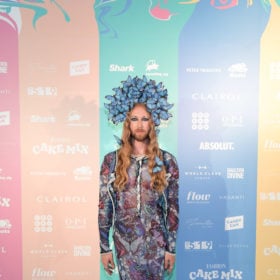
The dress code of the evening was “Monochrome Fantasy or Bougie Colour Blocking” (that’s fashion speak for wearing one colour head to toe or pairing unconventional colours together), and there were no blank canvases here. Sky blue, bright red and neon green were some of the most popular palettes, with many even matching their eyeshadows to their ensembles. Or in Myles Sexton’s case, their headpiece. The style expert, podcaster and AIDS advocate wore a beautiful butterfly headband they made themselves and a Jean Paul Gaultier dress, and might just be our pick for best dressed guest of the night.

When they weren’t slaying the red, er, tie dyed carpet, Sexton was hosting the Beauty Awards Pop-Up. Designed by interior designer firm Nivek Remas, the dreamy space brought the epic collaboration between Chatelaine, Châtelaine, FASHION and HELLO! Canada to life. The result was an immersive cloudscape (with literal clouds on the ceiling) that allowed guests to interact with award-winning products by Shark®, Clairol, Jean Paul Gaultier, OPI, VASANTI and more.

Just a brush stroke away was the Shark® Dream House hosted by Viktor Peters as Veruschka. When she wasn’t doing her own impression of Marilyn Monroe using the Shark® FlexBreeze fan (#slay), the drag and makeup superstar introduced guests to the brand’s hair tools, air purifiers and vacuums. Plus, the first 200 guests could scan a QR code and receive the product of their choice!

Photography by George Pimentel

And if you thought that was it for entertainment at the FASHION Cake Mix 2024 party, think again. The artist himself, Peter Triantos, worked on a live painting to be auctioned off for The 519. Fashion Art Toronto’s Vanja Vasic curated a Canadian designer exhibit including Suburban Deviant, Mayer, Tristan Réhel, Ali Haider, Zedes, Nova Chiu, and OAMA. And New York royalty DJ Lina Bradford slayed the house down, not just for her outfit (which, of course was beyond gorg) but for getting the real party started with a soundtrack that moved everyone onto the dance floor.

Add in some on-theme drinks from World Class Canada like the Peach Paloma which was inspired by Pantone’s colour of the year (Peach Fuzz) and a much-needed sugar rush from Fiorella Bakeshop, and the FASHION Cake Mix 2024 party was an artistic masterpiece, indeed.

See the gallery below where we’ve rounded up all the most memorable looks from FASHION Cake Mix 2024 and other highlights of the night.

Special thanks to the following:

The 519, Absolut Berry Vodkarita, Belif, Blue Lizard, Candy Can, Cereal Box Cafe, Clairol, DJ Lina Bradford, Fashion Art Toronto, Fiorella Bakeshop, Flexitol, Flow, Jean Paul Gaultier, Nivek Remas, OPI, Panoxyl, Peter Triantos Art Gallery, Real Techniques, Roots, Shark®, Squealing Pig Sauvignon Blanc, VASANTI, World Class Canada

The post Abstract Artistry + More Highlights from <em>FASHION’s</em> Cake Mix Party appeared first on FASHION Magazine.

[#content_feedzy_rewrite] 

Mir Yu On Identity, Imagination and Non-Binary Beauty

0

Mir Yu’s fascination with fashion can be traced back to his grandmother’s chiffon scarf. Growing up in the Jiangxi province of China, the content creator recalls seeing the gauzy pastel-pink piece tucked away in various parts of her home over the years, like a treasure waiting to be found. “I loved playing with it — wrapping it around myself as a cape and as a skirt,” he says, emphasizing the fluidity of the accessory. Seeing Yu’s style now, it’s not hard to believe that his sartorial sensibilities came from a single shape-shifting garment.

Take one scroll on the 33-year-old’s Instagram page, @mirintheparadise, and you’ll find a confection of colourful costumes that blur gender codes and deliver heavy doses of drama. His getups include everything from frothy tutus and towering headpieces to risqué cut-outs and severely cinched corsets. Radiating from this maximalist tableau is a definite theme: pure passion. “I went through so many phases, trying to put myself in a box,” he reflects, referencing the years he spent dressing traditionally masculine to fit in. “I tried to hide behind different identities.” But when he attended Pride Toronto in 2021 — seven years after moving to Canada — he decided to abandon binaries altogether. “I know who I am: a guy. I’m not changing that,” he says. “But I also love for my fashion to be genderless — gendermore.”

These days, his free-spirited outfit inspirations come from honouring what’s within. Maison Margiela and Harris Reed are labels that Yu admires for their rule-breaking runways, but his creations are born first and foremost out of his thoughts. Sometimes it’s as simple as a feeling. (What would it be like to embody pastel?) Other times it’s an inexplicable urge. (He recently felt a calling to construct leather overalls.) For this FASHION feature, he crafted an outfit around his identity as a Chinese gay man.

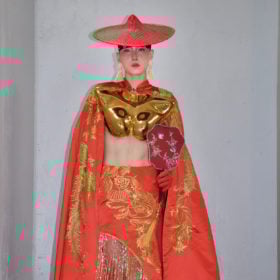
Using lush gold and red hues — a palette he describes as a “cliché” in his culture — Yu skilfully styled the below ensemble to push back on gender conventions. The result, a look he calls “Rouge,” is both rooted in his upbringing and rich with experimentation — not unlike his grandmother’s sheer scarf years ago.

Photography courtesy of Mir Yu

Here, Mir Yu breaks down the anatomy of his “Rouge” look.

Gilded Goodies

After Yu purchased these extravagant earrings at a market in Toronto’s Chinatown, they became his go-to jewellery pick. “I think these were my first attempt at seeing what I could do with Chinese accessories,” he says. Yu likes how the statement discs — a traditionally feminine design — mirror the round shape of his hat.

Headstrong

In China, this woven hat — a reportedly centuries-old design featuring straw material constructed in an inverted cone shape to protect against the sun — is called a “douli.” Yu recalls first seeing his grandfather’s brother wearing one while working on a farm in Jiangxi province. For Yu, it’s not just a practical piece but a powerful fashion statement. “I like how it can block the sun but also hide your eyes,” he shares. “It makes it a bit mysterious.”

Body Talk

When Yu ordered this moulded piece online, it came as a full-length mannequin that he then cut to make into a bustier. He was drawn to the broad shoulders and structured breasts and uses the armour-like accoutrement as a tool for blending masculine and feminine body images. “I wanted to show nudity in a more classic and creative way,” he explains. “Having the hard material to contradict the satin fabric makes it feel all the more gender fluid.”

It’s All In The Fan

“Love at first sight” is how Yu describes his initial impression of this type of fan, which he spotted for the first time on Instagram. “It’s a tuanshan, also called a ‘Chinese circular fan,’” he says, adding that it dates back centuries to the Shang Dynasty in Chinese history. “The fan represents good luck and blessings.” Not to mention, adding it to an outfit instantly makes him feel fancier.

Opening Up

Yu cut and transformed this garment, which was originally a one-shoulder dress, into a slitted skirt. The placement, revealing his midsection, is intentional. “A big part of my fashion is pushing back on mainstream ideas about Asian body types,” he says, citing the stereotype that Chinese men are undesirable. “It’s a stigma that Asians do not have good bodies, and that is something I need to change. Every time I show my abs in an outfit, I feel empowered by that message.”

Superpower Pairing

For many, an opulent cape might exude ultra-glamorous femininity. But for Yu, this cloak is brimming with masculinity — reminiscent of a swordsman embarking on a dangerous mission. “It’s inspired by Crouching Tiger, Hidden Dragon: Sword of Destiny,” he says, referencing the beloved 2016 film starring Michelle Yeoh as a Chinese warrior.

See more of Mir Yu’s fantastical fashion below.

This article first appeared in FASHION’s Summer 2024 issue. Find out more here.

The post Mir Yu On Identity, Imagination and Non-Binary Beauty appeared first on FASHION Magazine.

[#content_feedzy_rewrite] 

Is AI Racist?

0

AI. Two letters transforming every aspect of our lives, including our relationship with beauty. From skin analysis, shade-matching and virtual makeup try-on tools to experimenting with different hair and eye colours, our experience with beauty is changing.

Some of it is exciting. Artificial intelligence is driving cutting-edge innovations, boosting creativity by blending data-driven insights with fresh ideas and inspiring inventions outside traditional thinking. It also allows for better access to the world of beauty for mobility or visually impaired individuals. From the creation of easier to open packaging, larger fonts and virtual experiences to voice-activated AI tools offering guided makeup and skincare routines, AI-data integration has great potential.

But AI also poses one of the greatest threats to the representation of beauty. Because as beauty tools are getting an AI-overhaul, beauty ideals are narrowing.

Over the years, the emphasis placed on outside appearances has been amplified by the rise of AI. The value placed on looks has intensified pressure to be a certain type of beautiful, one that increasingly excludes Black and Brown women from the beauty narrative. For example, “photo filters commonly show racial biases by automatically lightening the skin tone during the ‘beautification’ process, aligning with Eurocentric (white) beauty norms” says Faiza Khan Khattak, PhD, applied machine learning scientist at the Vector Institute.

In fact, Beauty.AI recently used an artificial jury of “robot judges” to host the first online beauty contest judged by AI. Even in make-believe pageantry, the “judges” exhibited biases like those found in humans, particularly concerning physical traits such as skin tone and facial complexion, Khattak shared.

“The concern is that AI may amplify an already biased reality. The more people use these tools to create content, the more biased future models trained on this generated data could get,” explains Vered Shwartz, assistant professor of computer science at the University of British Columbia, Vector Institute faculty member and CIFAR AI chair.

In the early 2000s, most images of models and celebrities on magazine covers were Photoshopped. Breasts augmented. Waists cinched. Blemishes removed. Eyes widened. Skin lightened. And even though we knew it wasn’t real, we felt pressure to attain those unrealistic beauty standards. AI is the new Photoshop — on overdrive.

It feels like we are moving forward at lightning speed yet moving backwards even faster, according to the many experts. “We’ve allowed our limitations to be perpetuated by AI, instead of helping AI start off on a more inclusive digital footprint and model,” says Karlyn Percil-Mercieca, founder and chief equity storyteller at KDPM Equity Institute.

Research shows that by 2025, 90 per cent of the content we engage with could be AI-generated. According to Dove’s 2024 State of Beauty Report, two in five Canadian women feel pressure to alter their appearance because of what they see online — even when they know it’s fake or AI-generated. In fact, four in 10 women in Canada would give up at least a year of their life to achieve their beauty ideals. These are sobering statistics.

For many, fear about AI isn’t so much about machines taking over, it’s the singularity of the people teaching the machines: predominantly white males. Just last week, Meta announced its new AI advisory council, composed entirely of white men. Last year, OpenAI got into hot water after announcing its new board, also solely composed of wealthy, white men. If women and racialized people are excluded from AI datasets, there is a very real risk of harm that extends far beyond beauty.

AI robots trained on billions of images consistently identified “homemakers” as women and “criminals” as Black men. These “algorithmic biases” are not just insulting but can have serious implications for women and people of colour.

For example, AI is being used to help choose candidates for university admissions and filter job applicants. Even in the medical field, AI can assist in forecasting disease and mortality rates and suitable treatments for various health conditions. AI systems that have learned racism can have life-altering impact for people of colour.

I asked ChatGPT itself “is AI racist?” It answered: “AI itself is not inherently racist, but biases can be unintentionally introduced into AI systems due to various factors such as biased data, flawed algorithms, or inadequate testing. These biases can reflect and perpetuate societal prejudices if not addressed.” We’ve seen this with toxic stereotypes pulled from the internet, rife with pornography, misogyny, violence and bigotry — Asian men are weak, Asian women are fetishized, Black men are criminals that cannot be trusted and Black women cannot control their anger. The list is long and disturbing.

So how do we fix this problem? While we can’t change the past, we can influence AI moving forward. “We get ahead by addressing the elephant in the culture room. AI is built on the white racial frame and this is clearly visible through the examples of what/who is positioned as beautiful. While we know that Black and Brown is always beautiful, the harmful narrative AI perpetuates means that we must always be on guard against the limited and harmful lens of whiteness” says Percil-Mercieca.

“Tech companies must be held accountable for their actions in training AI. Integrate the intersectional research and lived experience wisdom lens of Black/African/Caribbean women and support the solutions they’ve provided. Hire them as consultants — and pay them equitably,” she says. A resource the KDPM offers is the Advancing AI toolkit, which anyone can access for free.

The Algorithmic Justice League encourages more diversity among AI coders. It was founded by Dr. Joy Buolamwini, an AI researcher motivated by personal experiences of algorithmic discrimination. An MIT grad student, working with facial analysis software, she noticed that the software couldn’t detect her face because of her skin colour. Only when she put a white mask over her face did it register. The coders hadn’t taught the algorithm different skin tones and sizes, rendering her invisible. Similarly, AI for Social Progress, launched by Luis Salazar, a Seattle tech entrepreneur, encourages the use of more diverse training sets.

Brands also play a significant role. “I would personally prefer if beauty brands post pictures of real people and promote their products in an honest way,” expresses Shwartz. “At the very minimum, I think that AI-generated images should be clearly labeled as AI-generated.”

A new Dove campaign, The Code, sheds light on the importance of women having the power to see real beauty reflected in new and emerging media. The brand has also made a commitment to never use AI-generated images in its advertising. It’s a major step in the right direction. Brands like Rare Beauty and Knix are also committed to featuring real women from diverse cultures, body shapes, sizes and abilities in their advertising.

As individuals, we are not powerless. “It is essential for us as a human community to collaborate, not just relying on AI or AI experts alone, to eliminate these biases and promote fairness,” emphasizes Khattak.

A big part of that is how we engage with AI tools. To help set new digital standards of representation, Dove recently created the Real Beauty Prompt Guidelines. The easy-to-use manual shows how we can create images that are more representative of Real Beauty on the most popular generative AI programs.

As stated in the manual, “There’s a rule to follow: if you don’t mention it in your prompt, AI won’t create it.” By being more specific with more diverse descriptions of humans in our prompts (age, race, ethnicity, skin body and other defining features), we can generate more realistic forms of beauty.

It’s crucial to remember that AI is human-made. Any racial bias is what humans have already shared on the internet. And whether we like it or not, AI isn’t going away. It’s how we teach and engage with AI moving forward that will influence its diversity, in beauty and beyond.

The post Is AI Racist? appeared first on FASHION Magazine.

[#content_feedzy_rewrite]